The 1876 season
|
The 1876 season |
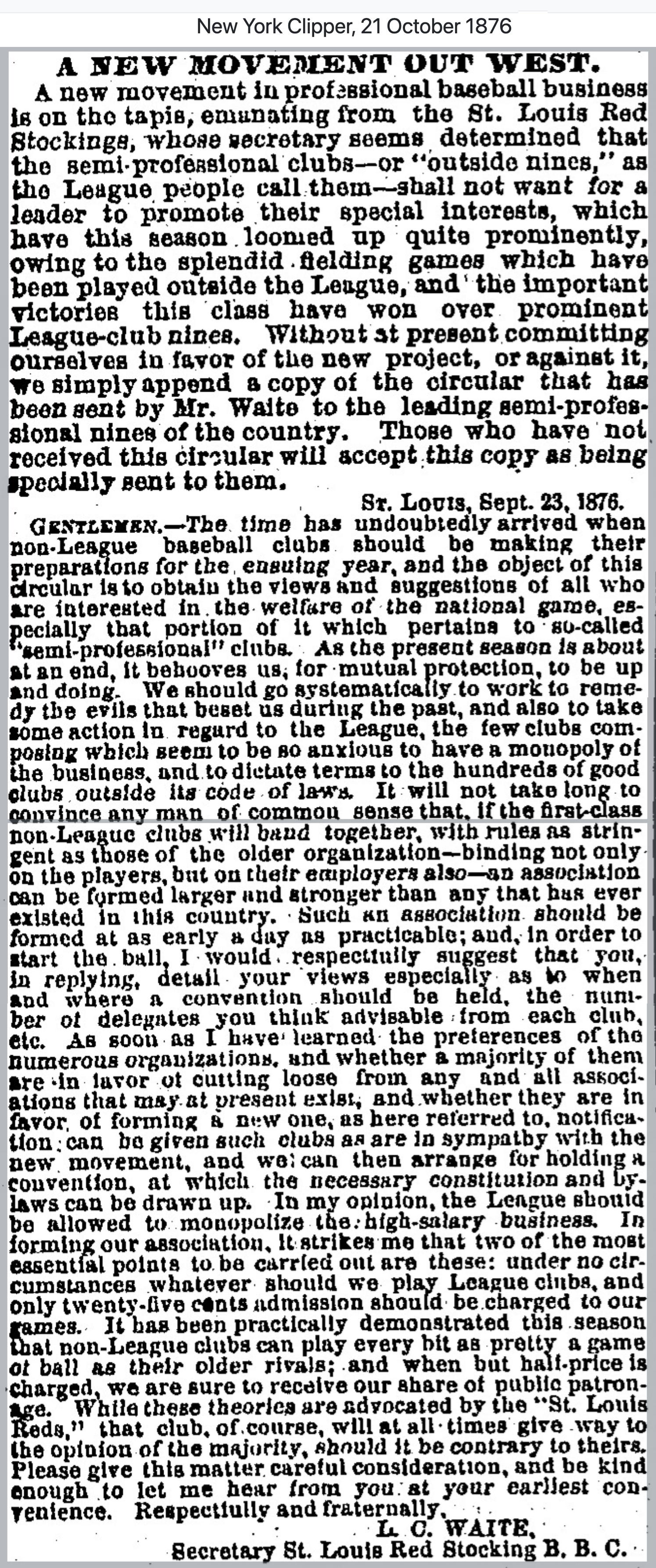
As the 1876 season wound down, club Secretary L. C. Waite sent out a letter to independent professional clubs proposing the formation of an Association to protect their interests from "the League, the few clubs composing which seem to be so anxious to have a monopoly of the business, and to dictate terms to the hundreds of good clubs outside its code of laws."(1) Included in the initial letter was the suggestion that "under no circumstances whatever should we play league clubs." Waite appeared to walk that back in a letter in the New York Hearld dated November 27, 1876. "In the circular several suggestions were made to expedite matters. They were merely suggestions to form a groundwork on which to operate when the Convention meets at Pittsburgh or wherever it is thought suitable it should."(2)
One of the key concerns for the independent clubs was the practice of "revolving," which was players jumping contracts with one club to take a higher-paid position elsewhere. While illegal among the League clubs, players often jumped between lesser clubs, or from "lesser clubs" to the League, as Collins did during the 1876 season. Teams in the proposed Association woudl promise to respect th contracts of other members (and indeed sought to end the practice entirely).
While some affiliated with the League expressed a willingness to work with the incipient organization, including Charles Fowle of the St. Louis Brown Stockings, the unofficial response from the League came from the Chicago club, which drew up a proposal of its own for a "League Alliance" in January 1877.(3) The League promised to respect contracts with Alliance teams, but required Alliance teams to submit to League rules and governance of all disputes. The International Association, as proposed by Waite, objected to this second clause, as they felt they should be allowed to settle their own disputes.
During the off-season, the feud between the League and the incipient Association continued in the papers, with Al Spalding and Waite exchanging a series of letters in the Globe-Democrat. The baseball world was split, with some publications supporting the League and its proposal, while others backed the incipient International Association.
Representatives for 18 clubs met in February, 1877, to establish an organization that would challenge the supremacy of the National League over all of professional baseball. L.C. Waite and Thomas McNeary represented the Reds. The final agreement adopted by the International Association at the meeting was very similar to that governing the League Alliance, organized by the National League as a direct challenge to the Association. The aims of the Association, as published in the New York Clipper, were:
First. To encourage, foster and elevate the game of baseball, to enact and enforce proper rules for the exhibition and conduct of the game, and to make baseball playing respectable and honorable.
Second. To protect and promote the mutual interests of baseball clubs and players, both professional and amateur.
In order to carry out these objects, we have adopted the most stringent rules for the punishment of revolving and other pernicious practices, and bind ourselves to stand by them.
(New York Clipper, March 10, 1877, pg. 2.)
The major difference between the two organizations was that the teams of the International Association refused to argree to allow its disputes to be settled by the National League. Otherwise, the rules it adopted almost entirely mirrored those of the National League and the League Alliance.
The International Association set up two tiers of membership. Basic membership cost $10, while an additional $10 was required to enter into the Cahmpionship series. By the end of April, seven teams had signed on for the Championship series, and many others had signed on to be a party to the organization. The St. Louis Reds were not among either group.
The club fully intended to join the Association whose creation L. C. Waite had initiated. On March 18, 1877, the club played its first pre-season game against the St. Louis Haymakers, winning by a score of 2-0. The full club that finished the 1876 season was present except Art Croft, who signed to play for the Browns in 1877, and John Magner, who signed with Columbus. The ninth man that day was White, identified as an old Reds substitute. They were scheduled to play the Athletics on April 1 for their second preseason game, but the newspapers that day carried the news that McNeary was disbanding the club. McNeary cited the inability to match the salaries of the top clubs as one reason. More significant, however, was the inability to play League clubs that came to St. Louis. This prohibition put the Reds at a financial disadvantage as compared to clubs in the League Alliance. McNeary felt the International Association was already a failure in its efforts to protect independent clubs from the League.
After the club disbanded, the remaining players scattered. Redmond joined the Memphis Reds, while Dolan and Galvin joined the Alleghenys. Jack Gleason joined the team in Minneapolis. Morgan and Bill Gleason initially stayed in St. Louis playing for the Atlantics, before Morgan joined the Milwaukee club and Bill Gleason joined his brother in Minnepaolis. Sullivan played with the Haymakers before catching on with the Evansville team.
Only Packy Dillon remained in St. Louis. He married Martha Baggot in 1875, and in the summer of 1877, she was pregnant. Sadly, their twins died at birth in November. They would go on to have six children. Dillon played sporadically with clubs in St. Louis over the next five years or so. His final appearance on the diamond was in 1886, on a team of old-times, in a benefit game for his old Reds teammate, Tom Sullivan.
The St. Louis Reds were re-incarnated over the years, but the club was never as strong or successful as it was during the 1875 and 1876 seasons. Over four seasons, the club compiled a record of 118-72. They were only 5-32 against clubs in the National League and National Association, but they were 113-40 against all other clubs, for a .739 winning percentage, establishing them as one of the top clubs in the country outside of the National League in their final two seasons. Going back to that first season, five players - Joe Blong, Johnny Peters, Dan Morgan, Billy Redmond and Trick McSorley - went on to have careers beyond the Reds, as did subsequent Reds Dan Collins, Silver Flint, Tom Loftus, Charlie Huatz, Art Croft, Joe Ellick, the Gleason brothers, Tom Dolan, Jim Galvin, John Magner and Tom Sullivan. Not bad for a club that is considered by most an afterthought in the National Association's final season.
The two seasons in which they challenged the Empires for supremacy in St. Louis generated the excitement and momentum that led to the formation of the St. Louis Brown Stockings, which ultimately set the foundation for St. Louis to establish itself as one of the top cities in professional baseball in the 1880s and beyond. The Reds help make St. Louis baseball crazy, and it remains so today.
The Reds played one game in 1877 before the club disbanded. The lineup was the same as that that finished the 1876, except Art Croft, who signed with the St. Louis Browns in the National League.
| Player | # games | Years with Reds | |
| Packy Dillon | 1 | 1873-1877 | Dillon played in St. Louis intermittantly for several years after the club disbanded in 1877. |
| Tom Dolan | 1 | 1875-1877 | Joined the Pittsburgh Alleghany of the International Association with Jim Galvin. |
| Jim Galvin | 1 | 1876-1877 | Joined the Pittsburgh Alleghany of the International Association with Tom Dolan. |
| Bill Gleason | 1 | 1876-1877 | Bill Gleason joined the Atlantics with Morgan in April. He signed with Minnesota in July, joining his brother Jack on the club. |
| Jack Gleason | 1 | 1876-1877 | Joined the Minneapolis Brown Stockings in May. |
| Dan Morgan | 1 | 1873-1877 | Played in more than 180 games from 1873-1877. Morgan joined the Atlantics with Bill Gleason in April. Later played with Minneapolis in the League Alliance. |
| Billy Redmond | 1 | 1873-1877 | Played in more than 180 games from 1873-1877. Signed by the Memphis Reds after the Reds folded. Later played with Cincinnati in the National League and Milwaukee in the League Alliance. |
| Tom Sullivan | 1 | 1876-1877 | Sullivan joined the Haymakers in April after the Reds folded. Signed with Evansville in early May. |
| White | 1 | 1874; 1876-1877 | White is identified as an old Reds sub in 1877 when he played in the final game for the club before it disbanded. |
(1) "What the Semi-Professional Clubs Intend Doing Next Season," St. Louis Globe-Democrat, October 20, 1876, pg. 3. The Democrat printed Waite's letter, dated September 23, 1876.
(2) "The National Game," New York Daily Herald, November 30, 1876, pg. 13. The International Assoiation formally met for the first time in Pittsburgh in mid-February, the convention mentioned in the letter.
(3) "An Interesting Interview in Relation to Base Ball," St. Louis Globe-Democrat, November 28, 1876, pg. 3. Fowle expressed a willingness to push League clubs to pledge to not interfere players under contract with clubs in the proposed Association and wanted the relationship between the League and the new organization to be friendly and cooperative.